
When troubleshooting audio hum or connecting gear to a PA system, musicians and sound engineers often confuse DI Boxes (Direct Injection Boxes) with Audio Ground Loop Isolators. While both devices help keep audio clean and can feature ground lift switches, they serve fundamentally different electronic functions in a signal chain.
Using the wrong box can result in weak signals, muffled tone, or persistent electrical noise.
What is a DI Box? (Direct Injection)
A DI Box is primarily designed to convert an unbalanced, high-impedance (Hi-Z) instrument signal (such as an electric guitar, bass, or passive keyboard) into a balanced, low-impedance (Lo-Z) microphone-level signal.
- Primary Function: Impedance matching and signal level step-down (Instrument Level $\rightarrow$ Mic Level).
- Key Feature: Allows long cable runs (up to hundreds of feet) to a mixing console’s microphone inputs without signal loss or high-frequency degradation.
- Typical Inputs/Outputs: 6.35mm (1/4″) TS Input $\rightarrow$ XLR Balanced Output.
What is an Audio Ground Loop Isolator?
An Audio Ground Loop Isolator is built specifically for line-level audio equipment (such as DJ mixers, laptops, audio interfaces, active speakers, or media players). It utilizes 1:1 Audio Isolation Transformers to physically separate input and output ground paths (Galvanic Isolation).
- Primary Function: Breaking ground loops and blocking electrical DC noise between line-level devices without changing impedance or attenuating signal voltage.
- Key Feature: Maintains 1:1 voltage ratio and line-level integrity while magnetically transferring audio across transformer coils.
- Typical Inputs/Outputs: Flexible matrix ports (XLR, 6.35mm TRS/TS, and RCA) for universal line gear integration.
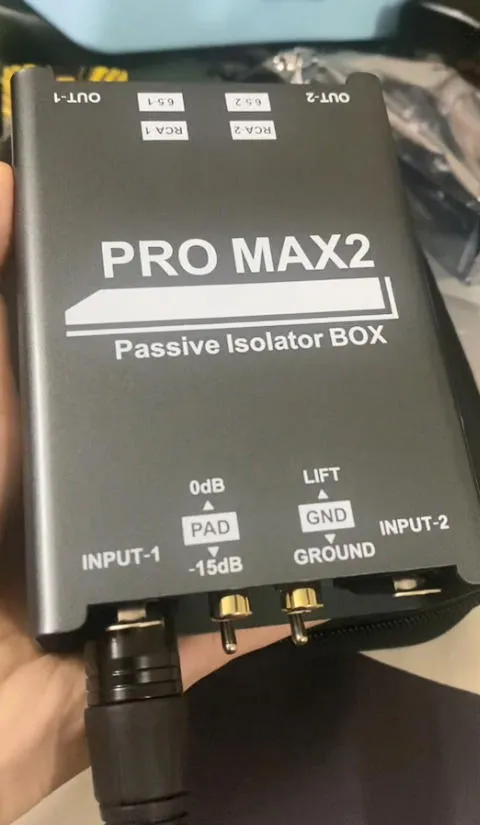
Key Differences at a Glance
| Feature / Specification | Standard DI Box | Line-Level Audio Isolator (e.g., PRO MAX2) |
| Primary Goal | Convert Hi-Z Instrument to Lo-Z Mic Level | Eliminate Ground Loop Hum & Digital Noise |
| Target Equipment | Guitars, Basses, Passive Keyboards | DJ Controllers, Laptops, Mixers, Studio Monitors |
| Signal Transformation | Step-down transformer (10:1 or similar ratio) | 1:1 Flat Ratio (Preserves exact signal level) |
| Input Signal Types | Unbalanced 1/4″ TS | Multi-Format Matrix (XLR / 6.35mm / RCA) |
| Output Destination | Mixer Mic Preamps (XLR) | Active Speakers, Mixers, Amplifiers, Recorders |
| Power Requirements | Passive or Active (Requires 48V Phantom) | 100% Passive (Zero power needed) |
Which One Do You Need for Your Setup?
Choose a DI Box If:
- You are plugging an electric guitar, bass, or electro-acoustic guitar directly into a stage box or mixing console.
- You need to convert a 1/4″ instrument jack into a mic-level XLR connection over a long stage cable run.
Choose an Audio Ground Loop Isolator If:
- You hear a 60Hz hum, buzz, or computer USB whine coming from your studio monitors, DJ controller, laptop, or mixer.
- You need to interconnect devices with different connector types (e.g., RCA outputs from a DJ controller to XLR inputs on an active subwoofer).
- You want to eliminate hum between line-level gear without reducing your output volume or feeding a microphone preamp.
The Ultimate All-in-One Line Solution: PRO MAX2
If your setup involves laptops, DJ equipment, or studio monitors, a standard instrument DI box isn’t the right tool for the job. The PRO MAX2 Passive Isolator BOX provides true 1:1 transformer isolation with dual XLR, 6.35mm, and RCA inputs and outputs, equipped with a GND LIFT switch and -15dB PAD to handle high line levels cleanly.
Frequently Asked Questions:
Can I use a DI box as a ground loop isolator for my DJ mixer?
Answer 1:
While a DI box with a ground lift switch can break a ground loop, it converts line-level signals down to mic level. This requires you to crank the gain on your mixer’s mic preamps, introducing unnecessary noise floor. A dedicated 1:1 audio isolator like the PRO MAX2 preserves full line-level volume without extra gain.
Does a passive ground loop isolator alter my audio frequency response?
Answer 2:
Cheap plastic isolators can choke low frequencies and muddy your sound. High-grade passive isolators featuring quality audio transformers maintain a completely flat frequency response (20Hz–20kHz) with zero signal degradation.
What is the purpose of the GND LIFT switch on an isolator?
Answer 3:
The GND LIFT switch disconnects the ground shield connection between input and output channels. When toggled, it stops electrical noise from circulating through the audio cable shield, eliminating ground loop hum instantly.