
When hunting down unwanted hum, buzz, or USB noise in an audio chain, choosing between a passive audio isolator and an active isolator is a critical decision. While both aim to eliminate noise, their internal architecture affects tone transparency, power requirements, and signal dynamics in completely different ways.
Using the wrong isolator type can introduce unwanted noise floor hiss or alter your frequency dynamics.
What is a Passive Audio Isolator?
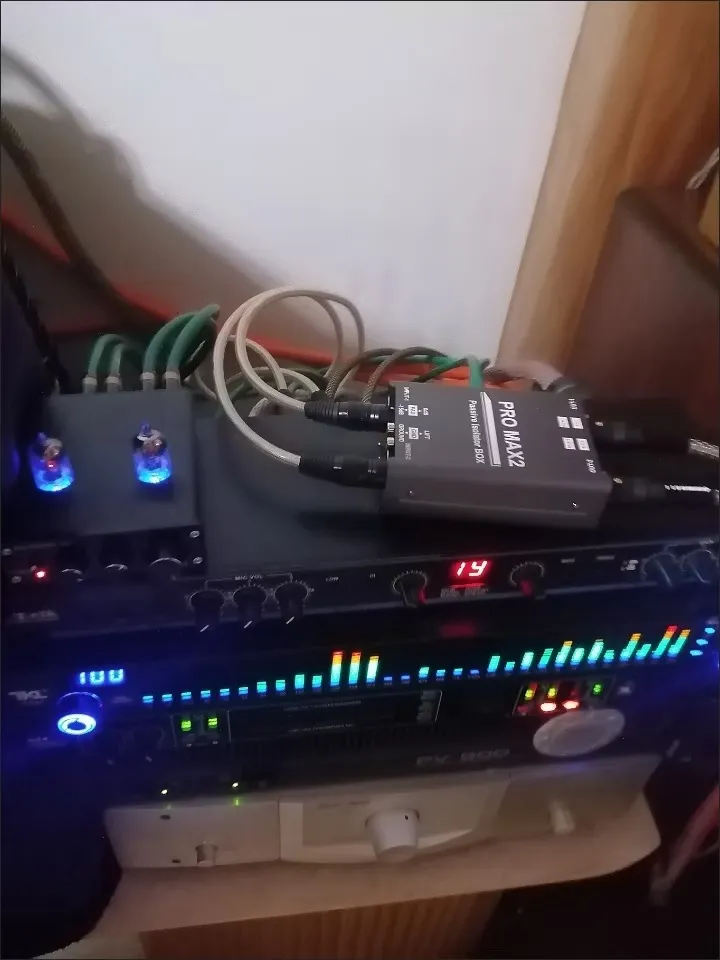
A passive audio isolator relies on precision-wound 1:1 audio transformers to physically separate the input and output electrical grounds (Galvanic Isolation). Signal passes magnetically across an air gap between transformer coils rather than flowing through direct wire connections.
- Power Requirements: 100% Passive (Requires zero batteries, external AC adapters, or 48V phantom power).
- Noise Floor: Extremely low (Contains no active electronics, transistors, or op-amps that add self-noise or thermal hiss).
- Best For: Line-level audio gear like DJ controllers, audio interfaces, studio monitors, laptops, and mixers.
What is an Active Audio Isolator / Buffer?
An active isolator uses powered electronic circuits (op-amps, differential amplifiers, or active buffer stages) to isolate or balance audio signals.
- Power Requirements: Requires constant external power (DC wall adapters, internal batteries, or 48V phantom power).
- Noise Floor: Variable (Active components can introduce semiconductor noise, distortion, or power supply ripple if power is unclean).
- Best For: High-impedance passive instrument pickups (like electric guitars or basses) needing signal boosting over long cable runs.
Passive vs. Active Isolator Comparison
| Feature / Metric | Passive Isolator (e.g., PRO MAX2) | Active Isolator / Buffer |
| Operating Principle | 1:1 Magnetic Audio Transformer | Powered Active Op-Amp Circuitry |
| Power Supply Needed | None (Plug-and-Play) | Requires AC Adapter, Battery, or 48V |
| Self-Noise / Hiss | Zero Added Noise Floor | Possible active circuit noise/hiss |
| Signal Level Handling | Excellent for Line Level (Studio/DJ) | Ideal for low-level Hi-Z instruments |
| Failure Points | Highly reliable (No active chips) | Fails completely if power is lost |
| Ground Loop Blocking | True Galvanic Separation | Differential ground filtering |
| Connector Versatility | Multi-Format Matrix (XLR / 6.35mm / RCA) | Usually single format (XLR or 1/4″ TRS) |
Which One Preserves Your Tone Better?
For line-level audio sources (audio interfaces, DJ mixers, keyboards, active speakers): A Passive Transformer-Based Isolator Preserves Tone Best.
- No Active Coloration: Active circuits add op-amp coloration and run the risk of clipping if your line signal exceeds the circuit’s power rail voltage. High-grade passive transformers pass audio without adding active harmonic distortion or semiconductor hiss.
- Zero Power Supply Interference: Active units require power cords or batteries—which can introduce their own power supply ripple or run out mid-performance.
- True Galvanic Isolation: Passive 1:1 transformers completely sever the copper wiring path between input and output, creating a total barrier against DC ground currents.
To handle hot line signals without transformer saturation, high-performance passive units like the PRO MAX2 Passive Isolator BOX feature a built-in -15dB PAD switch alongside a GND LIFT switch, providing pristine headroom and complete isolation across dual XLR, 6.35mm, and RCA matrix connections.
Frequently Asked Questions:
Does a passive audio isolator need phantom power from a mixing console?
Answer 1:
No. Passive audio isolators use internal magnetic transformers to transfer signal and require zero phantom power, batteries, or external power supplies. They are completely plug-and-play.
Can a passive audio isolator cause signal saturation or distortion?
Answer 2:
High-level output signals from DJ mixers or audio interfaces can saturate low-grade transformers. However, professional units like the PRO MAX2 feature a -15dB PAD switch to drop hot signal levels into the optimal range, guaranteeing zero distortion.
Is a passive isolator better than an active one for studio monitors?
Answer 3:
Yes. Studio monitor signals are already at line level. A passive transformer isolator provides pure galvanic ground separation without adding active circuit noise, hiss, or needing extra power outlets behind your desk.