
When dealing with an annoying 60Hz hum in your studio or DJ setup, it is tempting to order a $10–$15 plastic ground loop isolator from Amazon, Temu, or AliExpress. While these cheap devices claim to eliminate noise, many users discover a disappointing trade-off: the hum disappears, but so does their audio quality.
Cheap isolators often introduce muffled bass, high-frequency signal loss, and severe distortion. Here is the technical breakdown of what happens inside a $15 plastic box and why professional setups demand industrial-grade isolation.
The Hidden Flaws of $15 Plastic Isolators
1. Unshielded Plastic Enclosures (EMI/RFI Leakage)
Plastic does not conduct electricity, which also means it provides zero shielding against electromagnetic interference (EMI) or radio frequency interference (RFI). Placing a plastic isolator near laptop power bricks, Wi-Fi routers, or LED stage lights allows ambient electrical noise to bleed straight into the unshielded audio coils.
2. Inferior Transformer Coils & Bass Loss
To cut manufacturing costs, budget isolators use micro-sized, low-grade iron cores with thin copper windings. These cheap transformers suffer from severe low-frequency attenuation:
- Bass Roll-Off: Frequencies below 100Hz are severely choked, stripping the punch and sub-bass from your DJ tracks or studio mixes.
- Core Saturation: Line-level audio signals from DJ controllers or audio interfaces easily overload small cores, causing harsh harmonic clipping distortion.
3. Limited Connectivity & Connector Bottlenecks
Most $15 isolators only feature molded 3.5mm aux jacks or flimsy RCA pigtails. Forcing these consumer connections into a pro audio environment requires multiple adapters, creating additional point-of-failure resistance and loose connections.
What Makes a Professional Audio Isolator Different?
Professional isolators—like the PRO MAX2 Passive Isolator BOX—are engineered to solve electrical ground loops without sacrificing a single decibel of audio fidelity.
- Heavy-Duty Aluminum Chassis: An anodized aluminum enclosure acts as a full Faraday cage, blocking ambient RF and electromagnetic noise.
- 1:1 Flat-Response Audio Transformers: High-permeability nickel/iron alloy cores deliver a flat 20Hz–20kHz frequency response, preserving deep bass and crisp highs.
- Full Matrix Connectivity: Native support for balanced XLR, 6.35mm (TRS/TS), and RCA inputs/outputs eliminates the need for tone-degrading cable adapters.
- Pro Control Features: Built-in GND LIFT switches safely break ground loops, while a -15dB PAD switch prevents input overload from hot line signals.
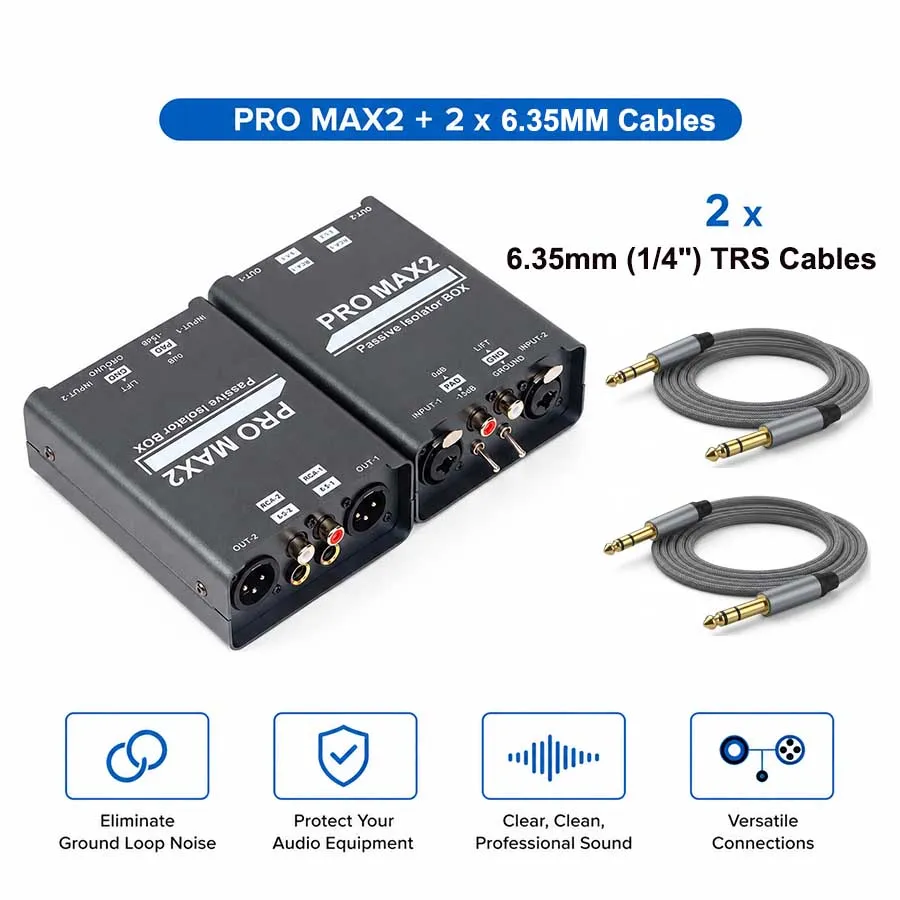
Direct Comparison: $15 Plastic Box vs. PRO MAX2
| Feature / Metric | $15 Plastic Budget Isolator | PRO MAX2 Professional Isolator BOX |
| Enclosure Material | Lightweight Unshielded Plastic | Heavy-Duty Anodized Aluminum |
| Frequency Response | Muffled (Loss below 100Hz) | Flat 20Hz – 20kHz (Zero Bass Loss) |
| Interference Protection | Poor (Picks up Wi-Fi / Power Buzz) | 100% Shielded Faraday Protection |
| Audio Connectors | 3.5mm Aux or Hardwired RCA | XLR + 6.35mm + RCA Matrix |
| Signal Handling | Distorts easily on hot signals | Dual 0dB / -15dB PAD Control |
| Ground Lift Switch | None (Fixed ground cut) | Dedicated Physical GND LIFT Switch |
Frequently Asked Questions:
Why does my audio sound muffled after connecting a cheap ground loop isolator?
Answer 1:
Cheap isolators use undersized transformer coils that cannot process low frequencies properly. This causes severe bass roll-off and chokes your dynamic range. A professional isolator with 1:1 high-grade transformers preserves flat frequency response from 20Hz to 20kHz.
Will a $15 plastic isolator work for live stage performances or DJ gigs?
Answer 2:
It is not recommended. Plastic enclosures offer no protection against heavy electromagnetic interference on stage (such as lighting rigs and power amps). Furthermore, cheap connectors lack the physical durability required for live performance environments.
Can I connect XLR, 6.35mm, and RCA cables simultaneously through a professional isolator?
Answer 3:
Yes. Multi-format isolation boxes like the PRO MAX2 support matrix conversions (e.g., RCA in to XLR out, or 6.35mm in to RCA out) while maintaining full galvanic ground isolation across all channels.