
Adding a active subwoofer to your studio setup or home theater system is supposed to deliver rich, room-shaking low end. But all too often, the moment you plug in that subwoofer RCA or XLR LFE cable, a deep, continuous 60Hz hum or high-pitched buzz fills the room—even when no audio is playing.
As an audio engineer with 20 years of experience in studio acoustics and system integration, I can tell you that subwoofer ground loops are among the most common and annoying issues in audio setups.
Because subwoofers are typically placed across the room near corner walls, they are plugged into different electrical outlets than your audio interface, AV receiver, or studio monitors. This spatial separation creates a prime environment for severe ground loop interference.
Here is why your subwoofer hums and how to eliminate the noise permanently without losing your deep sub-bass frequencies.
Why Subwoofers Are Vulnerable to Ground Loops
To understand why subwoofers buzz, you need to examine the electrical path between your main audio source and the subwoofer.
[ AC Outlet A (Desk) ]                           [ AC Outlet B (Corner) ]
 (Audio Interface / AV Receiver)                  (Active Subwoofer)
          │                                              │
          └─────────────► [ Subwoofer Cable ] ◄──────────┘
                        (RCA / XLR / 6.35mm)
                   (Ground Voltage Differential = 60Hz Hum)
- Distance & Power Circuits: Your audio interface or AV receiver is plugged into Outlet A at your workstation. Your subwoofer is plugged into Outlet B across the room. These two outlets often originate from different breakers or electrical sub-panels.
- Ground Potential Voltage Delta: Small voltage differences exist between Outlet A ground and Outlet B ground.
- The Shield Cable Loop: When you connect an RCA, XLR, or 6.35mm subwoofer line between the two devices, stray ground current flows through the audio cable’s copper shield to equalize the voltage gap.
- Amplified Low-End Hum: Because subwoofers are designed specifically to reproduce sub-audible and low frequencies (20Hz to 120Hz), the internal amplifier detects this 60Hz AC ground current and amplifies it directly through the driver as a loud, constant hum.
The Big Trap: Why Cheap Isolators Muffle Subwoofer Bass
When experiencing subwoofer hum, many users buy cheap $10 line isolators online. While these may reduce high-frequency buzz, they almost always ruin your sub-bass response.
Here is the physics of why cheap isolators fail on subwoofers:
- Transformer Core Saturation: Low frequencies (below 50Hz) require large magnetic cores and high-inductance copper windings to transfer energy magnetically without distorting.
- Bass Roll-Off & Muffling: Cheap isolators use tiny, undersized ferrite transformers. When fed low-frequency bass signals, the small core saturates instantly. This results in severe bass attenuation (rolling off frequencies under 60Hz), muddy transient response, and audible harmonic distortion on kick drums and sub-bass drops.
To fix subwoofer hum correctly, you need a high-headroom, pro-grade passive line isolator with custom-wound audio transformers rated down to 20Hz.
Step-by-Step Subwoofer Noise Diagnostics
Before buying new cables or gear, run this quick troubleshooting sequence:
Step 1: The LFE Signal Line Disconnect
Unplug the RCA or XLR signal cable from the back of the subwoofer while leaving the subwoofer powered ON.
- If the hum stops immediately: Your subwoofer amplifier is fine. The 60Hz noise is a ground loop entering via the audio signal shield.
- If the hum persists: The subwoofer is picking up magnetic interference from a nearby AC wall transformer, dirty power line noise, or an ungrounded power cord.
Step 2: Temporary Single-Outlet Extension Test
Run a temporary extension cord from your studio interface / AV receiver’s power strip across the room to power the subwoofer from the exact same outlet.
- If the hum disappears: You have proven 100% that a ground potential difference between wall outlets is causing the noise.
The Permanent Fix: True Galvanic Isolation with Sub-Bass Retention
To eliminate the ground loop permanently while keeping your subwoofer on its dedicated wall outlet, place a passive dual-channel line isolator between your audio source output (Interface/AV Receiver LFE Out) and the subwoofer input.
[ Audio Interface / AV Receiver ]
              │ (Sub Out / LFE Line)
              ▼
[ FS-ELEC PRO MAX2 Isolator ] ──► (Flat 20Hz Transformer Isolation + Ground Lift)
              │ (RCA / XLR / 6.35mm Out)
              ▼
[ Active Subwoofer ]  ===========> Pure, Silent, Room-Shaking Bass!
Why the FS-ELEC PRO MAX2 is Ideal for Studio & Home Theater Subwoofers
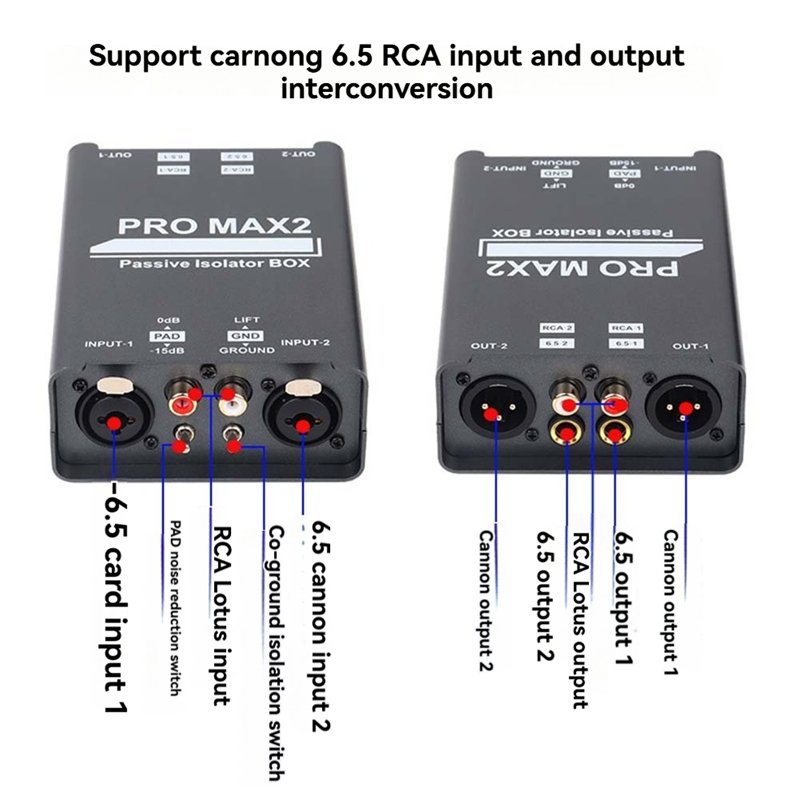
Unlike light-duty consumer dongles, the FS-ELEC PRO MAX2 is engineered with high-permeability Nickel-Laminated magnetic cores specifically designed to handle full-bandwidth audio down to 20Hz:
- 20Hz – 25kHz Flat Frequency Response (±0.2 dB): High-inductance custom transformers ensure sub-bass frequencies down to 20Hz pass through with zero signal loss, maintaining deep movie rumble and punchy studio kick drums.
- Universal Matrix I/O (RCA, XLR, 6.35mm TRS):
- Seamlessly connects AV receiver RCA LFE outputs to pro XLR studio subwoofers (e.g., Yamaha HS8S, KRK 10s, SVS, Genelec).
- Accepts dual 6.35mm TRS or XLR outputs from audio interfaces and routes them directly into stereo sub inputs.
- Pro-Grade Ground Lift Switch: Instantly breaks the copper shield wire connection between distant wall outlets, terminating 60Hz AC hum and GPU USB noise instantly.
- -15dB PAD Attenuation Switch: High-output receiver sub lines or DJ mixers can sometimes overload subwoofer inputs. The -15dB PAD switch provides clean level attenuation to prevent input clipping and distortion.
- Industrial Shielded Steel Chassis (470g): Heavy steel enclosure shields delicate internal transformer coils against electromagnetic radiation from nearby power strips and wireless AV gear.
Summary Checklist for a Quiet Subwoofer
- Never remove the AC safety earth pin on your subwoofer’s power cord.
- Verify whether the noise disappears when the signal cable is unplugged to confirm a ground loop.
- Insert a dedicated passive ground isolator like the FS-ELEC PRO MAX2 on the subwoofer signal line to break ground loops without losing deep sub-bass frequencies.
Frequently Ask Question:
A: Subwoofers are usually plugged into different wall outlets than receivers or interfaces. This creates a ground potential difference, causing 60Hz AC current to flow along the subwoofer audio cable shield.
A: Cheap isolators do because small transformer cores saturate on low frequencies. High-end isolators like the PRO MAX2 maintain a flat 20Hz response to preserve sub-bass depth.