
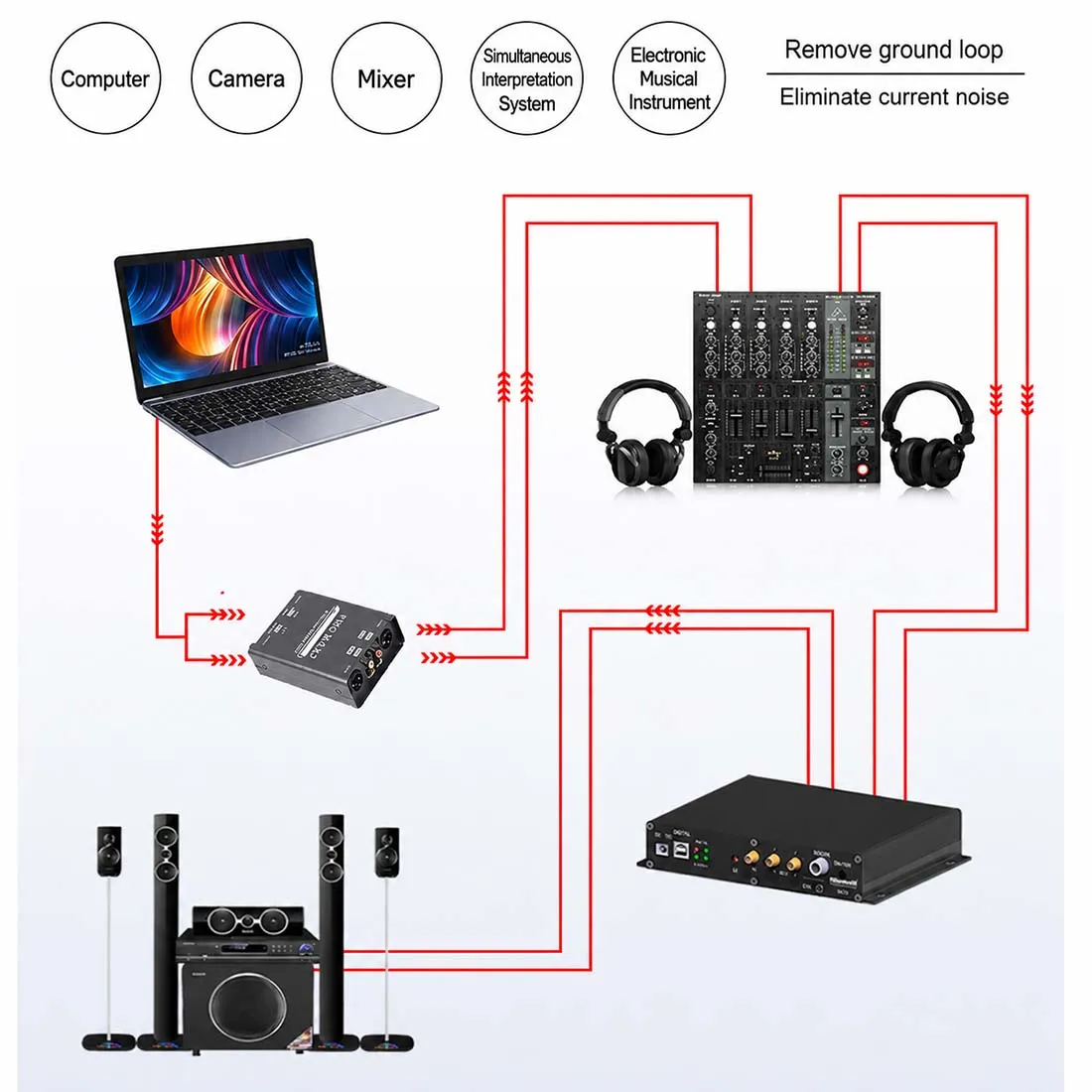
In church and house-of-worship sound systems, few things disrupt a worship service faster than an unexpected buzz, clicking hum, or radio interference echoing through the sanctuary during a quiet sermon or prayer.
Church AV operators face a unique physical challenge: long XLR cable runs spanning 100 to 300+ feet from the main mixing console in the back of the sanctuary to stage boxes, power amplifiers, or active speakers near the altar.
As an audio engineer with 20 years of experience in live sound and house-of-worship installations, I can tell you that while balanced XLR cables are designed to reject noise, long cable distances combined with complex church power grids often create severe ground loop and induction issues.
Here is why noise develops in long XLR runs and how to eliminate it permanently using professional isolation techniques.
Why Long XLR Runs in Churches Pick Up Noise
Even though balanced XLR connections utilize Common Mode Rejection (CMRR) to cancel out noise along the cable length, two major environmental factors routinely bypass this protection in church sanctuaries:
1. Multi-Phase AC Power Differential (The Primary Culprit)
In most church buildings, the sound booth at the rear of the sanctuary is powered by a different electrical circuit—or even a completely different electrical sub-panel—than the stage power outlets used for active speakers, keyboard rigs, and amplifier racks.
When your mixing console is plugged into Sub-Panel A and your powered main speakers or stage amps are plugged into Sub-Panel B:
- A ground potential difference (voltage delta) exists between the two earth grounds.
- Stray electrical current flows across the shielding wire of your long 150-foot XLR snake to balance out this voltage gap.
- Your PA system amplifies this continuous current as a low 60Hz hum or a harsh electrical buzz.
[ Sound Booth: Sub-Panel A ]                         [ Stage: Sub-Panel B ]
(Mixer / Wireless Receivers)                         (Amplifiers / Powered Speakers)
         │                                                        │
         └─────────────► [ 150ft XLR Snake ] ◄────────────────────┘
                     (Ground Voltage Differential = 60Hz Hum)
2. Dimmer Rack & LED Interference (EMI/RFI)
Churches frequently run stage lighting cables alongside audio snakes. High-power lighting dimmers, LED drivers, and HVAC units emit powerful electromagnetic interference (EMI). Over long distances, this noise bleeds into audio lines through capacitive coupling, causing high-pitched whine or buzzing whenever stage lights are dimmed.
Step-by-Step Church PA Noise Troubleshooting
Before replacing expensive snakes or running new conduit, follow this field-tested diagnostic sequence:
Step 1: Isolate the Signal Path
Mute all stage inputs on your mixing console one by one (wireless mics, keyboards, instruments).
- If the noise remains when all channels are muted: The hum is originating between the main mixer outputs and the house amplifiers/speakers down the line.
- If the noise stops when a specific stage box input is unmuted: The noise is coming from a specific stage device (e.g., an unbalanced keyboard, laptop, or guitar pedalboard plugged into an AC outlet on stage).
Step 2: Check Shield Continuity & Earth Lift
Never cut or tape off the safety earth pin on AC power plugs! “Cheater plugs” create a severe fire and electrocution hazard on live stage setups. Ground loops on audio lines must always be disconnected on the low-voltage audio line side, never the main AC power cord.
The Permanent Solution: Transformer Isolation & Ground Lifting
To completely eliminate noise on long XLR runs without running costly new AC conduit, you must introduce Galvanic Line Isolation at the boundary where the long cable run terminates (either right before the amplifier rack or right after the console output).
An audio isolation transformer converts the electrical signal into a magnetic field and regenerates a pristine audio signal on the other side—breaking the physical copper ground wire between distant electrical sub-panels.
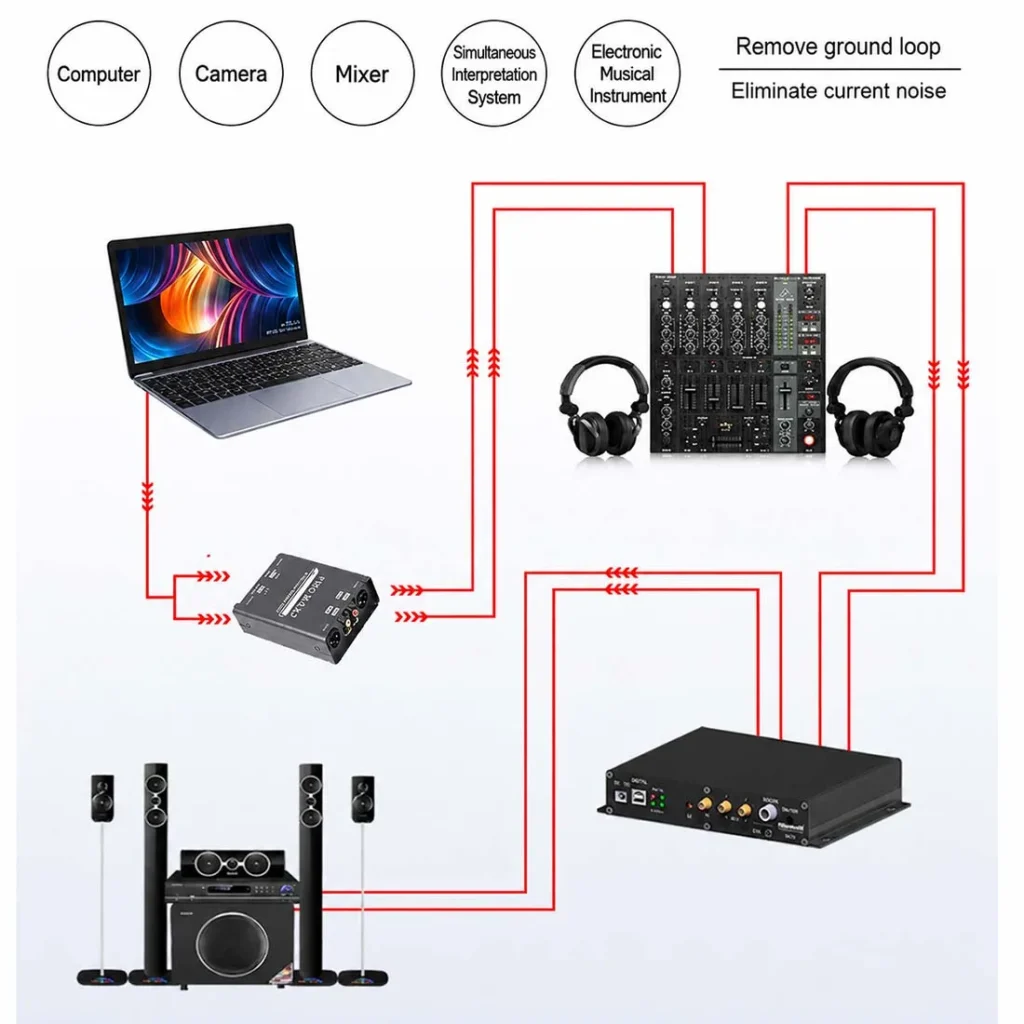
[ Mixing Console (Booth) ]
            │ (Long 150ft XLR Run)
            ▼
[ FS-ELEC PRO MAX2 Isolator ] ──► (Physical Transformer Break + Ground Lift)
            │ (Short XLR Jumpers)
            ▼
[ Main Amplifiers / Powered Speakers (Stage) ] ====> Silent Worship Audio!
Why the FS-ELEC PRO MAX2 is Built for Pro AV & Church Installations
For church AV directors and AV contractors, a multi-format isolator like the FS-ELEC PRO MAX2 provides a heavy-duty, tour-ready solution to solve long-run PA noise:
- 1500V Isolation Voltage Protection: High-isolation custom transformers protect sensitive digital mixing consoles and expensive power amplifiers against power surges, static electricity, and ground voltage spikes across long building runs.
- 20Hz – 25kHz Flat Frequency Response (±0.2 dB): Maintains deep 20Hz organ/sub-bass response and transparent high-frequency speech clarity for pastors without high-end roll-off or muddled vocals.
- Pro-Grade Ground Lift Switch: Instantly severs the shared shield connection between the sound booth and the stage at the flip of a switch, instantly eliminating multi-phase 60Hz hums.
- -15dB PAD Attenuation Switch: Wireless microphone receivers or long-distance line drivers often send ultra-hot line-level signals down the snake. Engaging the -15dB PAD prevents input stage clipping and distortion on sensitive mixer preamps.
- Dual XLR / 6.35mm / RCA Matrix: Allows native conversion if your church uses 6.35mm line outputs from a secondary board or RCA feeds for video streaming/overflow rooms, routing them directly into main balanced XLR inputs without tone-degrading dongles.
- Road-Ready Shielded Metal Chassis (470g): Heavy industrial steel casing blocks external RFI/EMI from nearby church lighting dimmers and wireless systems.
Summary Checklist for Quiet Church Sound
- Never compromise safety by lifting main AC power ground pins on amplifiers or mixers.
- Route long audio XLR snakes away from high-voltage AC cables and stage lighting dimmer lines.
- Place a dual-channel passive isolator like the FS-ELEC PRO MAX2 between your sound booth output and your stage amp racks to permanently sever multi-phase ground loops.
Frequently Ask Question:
A: Stage dimmers emit electromagnetic interference (EMI) that bleeds into long audio snakes running parallel to lighting power lines. A passive isolator helps reject induced ground noise.
A: No! Removing AC safety ground pins creates a severe electrocution hazard for musicians and operators. Ground loops must always be lifted safely on the low-voltage audio signal side.